

Metaverse Market Projected to Surpass USD 4,495.56 Billion at 38.0% CAGR by 2035
Metaverse Market
Metaverse Market is expanding through immersive virtual worlds, digital commerce, gaming, social platforms, and enterprise applications.
Metaverse Market is reshaping digital interaction by combining virtual worlds, immersive experiences, digital commerce, gaming, and enterprise applications”
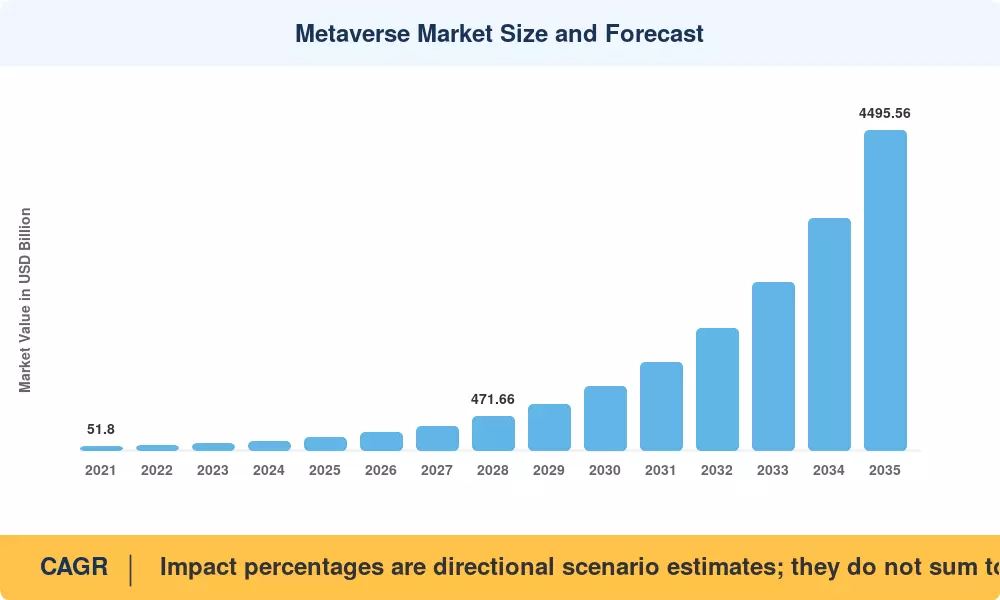
BERLIN, BERLIN, GERMANY, September 2, 2026 /EINPresswire.com/ -- The Metaverse Market is experiencing rapid expansion as enterprises and consumers increasingly adopt virtual environments, spatial computing, extended reality, and immersive digital platforms. The market reached an estimated USD 179.47 billion in 2025 and is projected to reach USD 4,495.56 billion by 2035, advancing at a CAGR of 38.0% during the forecast period. Increasing investment in XR infrastructure, AI-powered content, 5G connectivity, and enterprise virtual environments is strengthening market development.— Market Research Future
The increasing use of virtual worlds, augmented reality, virtual reality, and mixed-reality applications is creating new opportunities across entertainment, gaming, education, healthcare, retail, and enterprise operations. Businesses are increasingly exploring immersive environments for collaboration, training, product visualization, and customer engagement. Improvements in cloud infrastructure, artificial intelligence, 5G connectivity, and spatial computing are further supporting the development of scalable metaverse ecosystems.
Get a Sample PDF of the Report at -
https://www.marketresearchfuture.com/sample_request/10744
Growing Adoption of Metaverse Platforms
Metaverse platforms are moving beyond entertainment toward enterprise collaboration, industrial simulation, virtual commerce, healthcare training, education, and digital-twin applications. Organizations are increasingly exploring persistent virtual environments to improve customer engagement, workforce training, product development, and remote collaboration. Government digital-infrastructure initiatives and investments in immersive technologies are also creating new opportunities for platform developers and technology providers.
Artificial Intelligence in the Metaverse
Artificial intelligence is becoming an important technology for creating dynamic and personalized virtual environments. Generative AI can support the development of three-dimensional objects, digital characters, environments, and interactive content while reducing manual production requirements. AI can also personalize user experiences by adapting virtual spaces, recommendations, interactions, and digital assistants according to individual behavior and preferences.
Extended Reality Technology
Virtual reality, augmented reality, and mixed reality are fundamental technologies supporting metaverse development. VR provides fully immersive environments, while AR overlays digital information onto physical surroundings and mixed reality combines digital objects with real-world environments. Advances in displays, sensors, spatial tracking, processors, and lightweight wearable devices are improving the quality and usability of immersive experiences.
5G and Low-Latency Connectivity
The expansion of 5G networks is supporting metaverse applications that require rapid data transmission and responsive interaction. Low-latency connectivity can improve multiplayer virtual experiences, remote collaboration, immersive commerce, industrial simulations, and real-time digital-twin applications. Network slicing and edge computing can further support demanding applications by bringing processing resources closer to users and connected devices.
Cloud and Edge Computing
Cloud and edge infrastructure provide the computing capabilities required to deliver complex virtual environments at scale. Cloud platforms can handle large amounts of graphics, user data, and application workloads, while edge computing can reduce latency for interactive applications. This combination is particularly valuable for enterprise metaverse deployments involving real-time collaboration, digital twins, remote operations, and immersive training.
Digital Twin Applications
Digital twins are becoming a major enterprise opportunity within the Metaverse Market. Companies can create virtual representations of factories, buildings, products, machines, and supply chains to simulate operations before making physical changes. Digital twins can support predictive maintenance, virtual commissioning, product development, workforce training, and operational optimization, providing measurable business value beyond consumer-oriented virtual worlds.
Metaverse in Gaming and Esports
Gaming and esports remain major applications for metaverse technologies because players are already familiar with persistent virtual worlds, digital identities, virtual goods, and social interaction. According to Market Research Future, gaming and esports represented 46% of market revenue in 2024. Continued development of user-generated content, multiplayer experiences, virtual events, and digital economies is expected to sustain demand across this segment.
Virtual Commerce and Retail
Virtual commerce is creating new opportunities for retailers and consumer brands by enabling interactive digital storefronts, virtual product demonstrations, immersive advertising, and digital try-on experiences. Businesses can use metaverse environments to connect entertainment with purchasing and customer engagement. As AR devices become more accessible, consumers may increasingly discover products through spatial interfaces rather than relying exclusively on conventional websites and mobile applications.
Healthcare and Medical Training
Healthcare is emerging as an important application area for immersive technology. Virtual environments can support medical education, surgical simulation, therapy, rehabilitation, and professional training without requiring physical replication of every training scenario. Healthcare organizations can use digital simulations to provide repeatable learning environments, while researchers continue exploring immersive tools for patient engagement and specialized clinical applications.
Education and Workforce Training
The education sector is increasingly evaluating immersive learning because virtual environments can provide interactive simulations that are difficult to reproduce in conventional classrooms. Students can explore historical locations, scientific models, laboratories, and complex environments through immersive experiences. Businesses can also use virtual training centers for employee onboarding, technical instruction, safety exercises, and skills development across geographically distributed workforces.
Buy Latest Edition of Market Study Now:
https://www.marketresearchfuture.com/checkout?currency=one_user-USD&report_id=10744
Enterprise Collaboration
Metaverse technologies can create spatial collaboration environments where employees interact through avatars, virtual workspaces, and three-dimensional models. These environments can support design reviews, engineering collaboration, meetings, training, and remote assistance. As organizations operate increasingly distributed teams, immersive collaboration may complement traditional video conferencing and provide richer interaction for activities requiring visualization and shared spatial context.
Industrial Metaverse
The industrial metaverse is gaining attention because it connects immersive technologies with manufacturing, engineering, logistics, and operational processes. Businesses can use virtual environments to simulate factories, test equipment configurations, train workers, and visualize production workflows. Industrial applications are particularly attractive because companies can measure potential improvements in productivity, maintenance, safety, and operational planning.
Metaverse Revenue Models
The Metaverse Market is developing through multiple revenue models, including advertising, subscriptions, direct consumer spending, virtual goods, NFTs, and industrial services. Advertising remains an important source of revenue for consumer-oriented platforms, while subscriptions and enterprise services can generate recurring income. Industrial digital-twin applications may provide longer-term contracts because businesses often require ongoing simulation, analytics, and platform support.
Hardware Market Development
Hardware remains an important component of metaverse ecosystems, including head-mounted displays, sensors, controllers, haptic technologies, and other spatial-computing devices. Market Research Future reports that hardware captured the largest component share in 2024, reflecting demand for mixed-reality equipment. Improvements in display quality, processing performance, ergonomics, and device pricing are expected to influence broader adoption.
Software Platforms
Software platforms provide the operating environments, development tools, virtual-world frameworks, and applications required to create immersive experiences. Enterprises increasingly need software that can integrate with existing ERP, CRM, product lifecycle management, analytics, and cloud systems. As deployments become more complex, platform interoperability and developer tools are becoming increasingly important competitive factors.
Services and Consulting
Services and consulting are expected to experience rapid growth as enterprises require specialized expertise to implement immersive platforms. Businesses may need assistance with application development, digital-twin creation, system integration, spatial analytics, cybersecurity, and workforce training. Market Research Future identifies services and consulting as a fast-growing component, reflecting the complexity of enterprise metaverse deployments.
North America Metaverse Market
North America holds the leading regional position, representing approximately 44% of global Metaverse Market revenue. Strong hyperscaler infrastructure, technology investment, an established creator economy, and a large XR development ecosystem support regional leadership. Major technology companies and startups continue developing spatial-computing hardware, platforms, cloud infrastructure, AI tools, and immersive applications across consumer and enterprise markets.
Browse In-depth Market Research Report:
https://www.marketresearchfuture.com/reports/metaverse-market-10744
Asia-Pacific Metaverse Market
Asia-Pacific is expected to be the fastest-growing regional market, with a projected CAGR of approximately 47% through 2035. Government initiatives, digital transformation, mobile connectivity, gaming ecosystems, and investments in immersive technologies are supporting regional expansion. China, South Korea, Japan, India, and Southeast Asian economies are creating opportunities across gaming, education, digital twins, retail, entertainment, and enterprise applications.
Europe Metaverse Market
Europe represents another important regional market, supported by industrial digitalization, immersive technology development, and growing interest in interoperability. The region accounts for roughly 22% of market revenue according to the cited market analysis. European businesses are particularly interested in industrial digital twins, manufacturing simulations, workforce training, and enterprise applications that can deliver measurable operational value.
Metaverse in South America
South America presents emerging opportunities as digital commerce, gaming, fintech, and mobile connectivity continue to expand. Brazil represents an important market because of its large digital consumer population and established gaming ecosystem. Metaverse applications can create opportunities in virtual commerce, entertainment, financial services, education, and digital communities as supporting infrastructure becomes more widely available.
Middle East and Africa Opportunities
The Middle East and Africa are developing metaverse opportunities through smart-city initiatives, digital infrastructure programs, tourism, education, and virtual experiences. Countries such as the United Arab Emirates and Saudi Arabia are exploring immersive technologies as part of broader digital transformation strategies. Digital twins and spatial computing can support urban planning, tourism development, infrastructure visualization, and public-sector applications.
Metaverse and Web3 Integration
Web3 technologies can contribute decentralized ownership, digital assets, blockchain-based identity, and community-driven economic models to virtual environments. Open decentralized platforms can allow users to participate in digital economies and potentially transfer assets between compatible ecosystems. However, interoperability, regulation, scalability, security, and user experience remain important considerations for broader Web3 metaverse adoption.
Privacy and Data Security
Privacy and cybersecurity are significant challenges because immersive platforms can collect extensive information about users, devices, interactions, and behavior. VR and AR systems may process sensitive biometric and behavioral information, creating additional governance requirements. Platform providers must implement strong authentication, encryption, access controls, data minimization, and transparent privacy practices to build trust among consumers and enterprise customers.
Hardware and Infrastructure Costs
High device and infrastructure costs can restrict metaverse adoption, particularly in emerging economies. Advanced XR headsets, enterprise spatial-computing equipment, high-performance computing, and reliable connectivity can require significant investment. Reductions in component costs, cloud delivery models, mobile AR applications, and improved device accessibility could gradually reduce these barriers and expand the addressable user base.
Motion Sickness and User Experience
User experience remains an important consideration for immersive technologies. Motion sickness, device weight, limited battery life, visual fatigue, and complicated interfaces can reduce the amount of time users are willing to spend in virtual environments. Manufacturers are working on improved optics, tracking systems, ergonomics, rendering technologies, and display architectures to make extended immersive sessions more comfortable.
Interoperability and Open Standards
Interoperability is becoming increasingly important as multiple metaverse platforms compete for users and developers. Consumers and businesses may prefer ecosystems where identities, content, and digital assets can operate across compatible platforms. Open standards could reduce platform fragmentation and encourage innovation, while closed ecosystems may retain stronger control over content, user experience, and monetization.
Sustainability of Metaverse Infrastructure
The expansion of immersive computing can increase demand for GPUs, data centers, network infrastructure, and edge computing resources. As a result, energy consumption and environmental impact are becoming important considerations for platform operators. Renewable energy, efficient processors, optimized rendering, edge infrastructure, and sustainable data-center practices can help reduce the environmental footprint associated with large-scale virtual environments.
Competitive Landscape
The Metaverse Market includes technology companies, gaming platforms, hardware manufacturers, cloud providers, semiconductor companies, and immersive-content developers. Major players identified by Market Research Future include Meta Platforms, Microsoft, Apple, NVIDIA, Epic Games, and Roblox Corporation. Competition is focused on hardware, operating systems, developer ecosystems, cloud infrastructure, AI capabilities, content, and enterprise applications.
Emerging Metaverse Trends
Generative AI, spatial computing, digital twins, 5G, edge computing, immersive commerce, and open standards are expected to influence the next phase of market development. AI-generated environments can reduce content-development costs, while digital twins can expand enterprise use cases. At the same time, lower-cost AR devices and mobile-based experiences could make immersive applications more accessible across emerging markets.
Future Outlook for Metaverse Market
The Metaverse Market is positioned for substantial long-term expansion as immersive technologies transition from experimental applications toward commercial and industrial deployments. The market is projected to increase from USD 179.47 billion in 2025 to USD 4,495.56 billion by 2035, reflecting a 38.0% CAGR. AI-native virtual worlds, industrial digital twins, immersive commerce, healthcare simulation, and spatial collaboration are expected to create significant opportunities during the forecast period.
Frequently Asked Questions:
What is the Metaverse Market?
The Metaverse Market includes technologies, platforms, hardware, software, and services that enable persistent immersive digital environments and experiences.
What will the Metaverse Market be worth by 2035?
The market is projected to reach approximately USD 4,495.56 billion by 2035, growing at a CAGR of 38.0%.
What is driving the Metaverse Market?
AI, XR hardware, 5G, cloud computing, digital twins, gaming, virtual commerce, and enterprise adoption are major growth drivers.
Which region is growing fastest?
Asia-Pacific is expected to register the fastest regional growth, supported by government initiatives and digital transformation across major economies.
Which industry leads metaverse adoption?
Gaming and esports currently represent the largest end-user segment, while corporate and industrial applications are growing rapidly.
How is AI changing the metaverse?
AI can automate content creation, personalize virtual experiences, generate digital assets, and support intelligent virtual environments.
What are major metaverse challenges?
High hardware costs, privacy concerns, motion sickness, cybersecurity, interoperability, content moderation, and infrastructure requirements remain important challenges.
What are the key metaverse opportunities?
Immersive commerce, healthcare simulation, industrial digital twins, education, workforce training, virtual entertainment, and spatial analytics offer significant opportunities.
➤➤ Regional & Country-Level Reports by Market Research Future:
Canada Metaverse Market -
https://www.marketresearchfuture.com/reports/canada-metaverse-market-60647
China Metaverse Market -
https://www.marketresearchfuture.com/reports/china-metaverse-market-60650
Europe Metaverse Market -
https://www.marketresearchfuture.com/reports/europe-metaverse-market-60649
France Metaverse Market -
https://www.marketresearchfuture.com/reports/france-metaverse-market-60646
Gcc Metaverse Market -
https://www.marketresearchfuture.com/reports/gcc-metaverse-market-60648
Germany Metaverse Market -
https://www.marketresearchfuture.com/reports/germany-metaverse-market-60644
Italy Metaverse Market -
https://www.marketresearchfuture.com/reports/italy-metaverse-market-60983
Japan Metaverse Market -
https://www.marketresearchfuture.com/reports/japan-metaverse-market-60645
Uk Metaverse Market -
https://www.marketresearchfuture.com/reports/uk-metaverse-market-60643
Market Research Future
Market Research Future
+1 855-661-4441
email us here
Legal Disclaimer:
EIN Presswire provides this news content "as is" without warranty of any kind. We do not accept any responsibility or liability for the accuracy, content, images, videos, licenses, completeness, legality, or reliability of the information contained in this article. If you have any complaints or copyright issues related to this article, kindly contact the author above.
